Petite M
Use the player controls above to browse inventory.
Crossed-out listings are unavailable.
| Name | W x H" | Price |
|---|---|---|
| GRP.127 | 21 x 22" | $100 |
| GRP.128 | 19 x 20" | $100 |
| GRP.129 | 19 x 21" | $135 |
| GRP.130 | 18 x 20.5" | $45 |
| GRP.131 | 18 x 18" | $35 |
| GRP.132 | 21 x 25" | $200 |
| GRP.133 | 18 x 21" | $100 |
| GRP.134 | 18 x 19" | $85 |
| GRP.135 | 18 x 15" | $85 |
| GRP.136 | 18 x 23" | $85 |
| GRP.137 | 19.5 x 22.5" | $65 |
Due to the high volume of GRP inventory,
orders must be placed upon request.
Click below to get started.
What Is The Program?
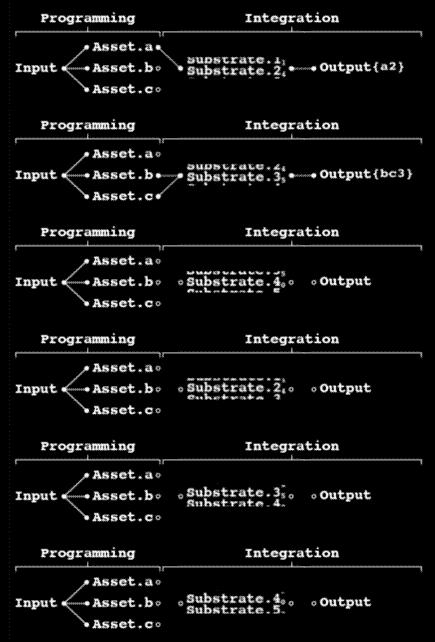
The program is a creative formula generating multiple unique outcomes from a single input. This formula is inspired by emergent art which uses autonomous systems such as computer software and robotics to produce compositions. Instead of STEM algorithms, the program uses physical substrates as the system for generating outcomes. In practice, the program combines a creative concept with emerging resources to produce unforeseen works of art.

Chrysanthemum variations
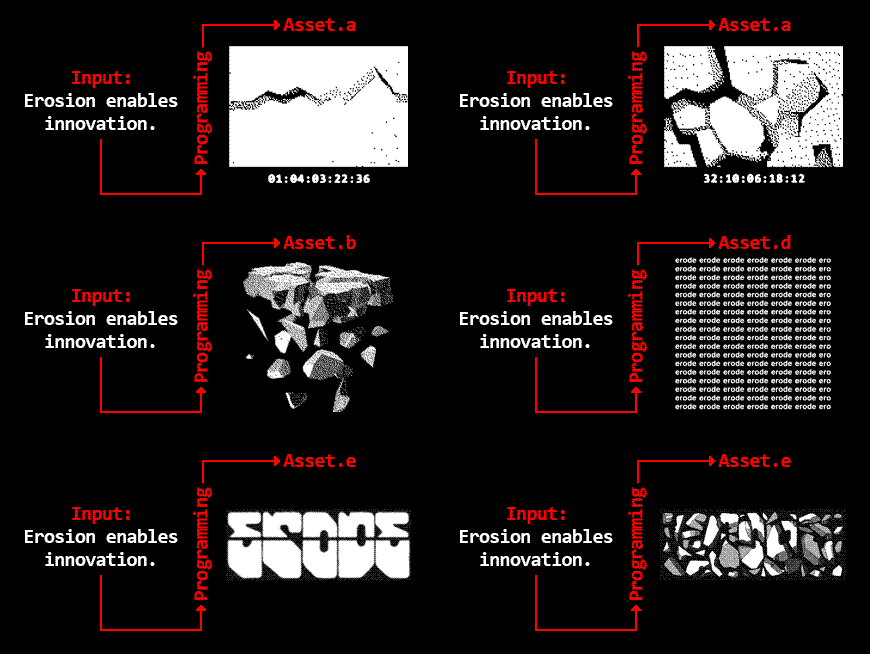
The formula divides into two parts: programming and integration. The programming side consists of an input and a set of assets. The input is an overarching concept, and the assets exemplify the concept in physical form.
The integration side of the formula pairs assets to a substrate resulting in a final output. A substrate is any given physical material that assets are being applied to. Substrates are denoted by their relative texture (t). Texture determines the amount of preexisting variation a substrate carries rated on a scale of 0 to 5. A 0 rating implies no texture (ex. a blank canvas), and 5 implies a substrate is heavily textured (ex. a severely degraded textile). Texture helps determine complementary combinations between substrates and assets. Creative methods are then used to integrate the set into a final output.
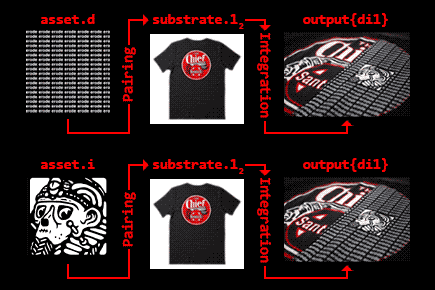
The program is a guide, not an automated process. Successful outcomes are determined by three principles:
- Develop concepts inspired by available resources.
- Create versatile assets capable of communicating the concept on a variety of substrates.
- Utilize diverse substrates that push the concept beyond its original context.
These principles ensure equitable collaborations between concept and resources.
